Equine Hindgut Basics — Why Mineral Balance Matters
OmniVita WellnessShare
The working horse's gut is where most of his daily output is built. Why mineral balance and absorption matter more than the supplement bottle on the front shelf — and what most ranch and barn supplement stacks miss.
Hindgut quick anatomy.
The horse is a hindgut fermenter. Unlike a cow (a true ruminant with a four-chamber stomach), the horse has a single-chamber stomach and does most of his fiber fermentation in the cecum and large colon — the "hindgut." That's where roughage gets broken down by the gut microbiome and converted into the volatile fatty acids that supply the horse with the bulk of his daily energy.
The hindgut is roughly two-thirds of the horse's total gastrointestinal volume. It's also the part most owners pay the least attention to, because it sits quiet most of the time. The stomach gets the attention — gastric ulcer products, omeprazole, the whole shelf at the tack store. The hindgut does the work.
When the hindgut is working well, you see it in coat, condition, manure quality, recovery between hard work, and steady weight on grass and hay alone. When it's struggling, you see it in stiffness, dull coat, weight loss despite calories, and the kind of unsteady performance that doesn't quite explain itself.
Why mineral balance specifically.
The horse's body runs on electrical signaling. Muscle contraction, nerve impulse transmission, recovery between bouts of effort — all of it is electrical. The minerals that carry those electrical signals are called electrolytes: potassium, sodium, magnesium, calcium, chloride, sulfate. The ratios between them matter as much as the total amount of each.
If the ratio is off — too much sodium relative to potassium, too little magnesium relative to calcium — every workout costs more energy and every recovery takes longer than it should. The horse can still perform. He just performs with a tax on top.
Most pasture-based diets do not supply the full electrolyte panel in the ratios the working horse needs. Forage quality varies by region, by season, by grass species. The standard ranch supplement stack — a mineral block, a fly-control supplement, an electrolyte mix, a separate joint supplement — is the industry's attempt to patch the gaps, and it works, more or less, at the cost of complexity and money.
The absorption angle.
Here's the part most equine supplement marketing skips. The form the mineral is in matters as much as the amount on the label.
Most mineral supplements deliver minerals as salts — magnesium oxide, copper sulfate, zinc sulfate. The horse's body has to break those salts apart in the gut before the minerals can be absorbed. Ionic minerals are different. They're already in the dissociated form the body recognizes, which means more of what's in the scoop reaches where it's supposed to go.
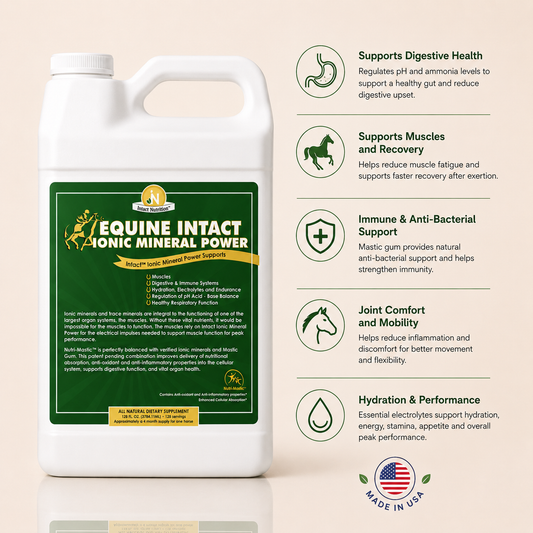
Equine Intact™ uses seawater-derived ionic and trace minerals for exactly this reason. The mineral panel is delivered in the form the horse's body is built to take up at the cellular level. The label dose is one scoop (~1.1 oz) per day for the standard working horse, mixed into feed.
Why we added mastic gum.
The ionic mineral panel handles the electrical signaling side. The mastic gum component handles the gut-environment side.
Mastic gum — from the resin of Pistacia lentiscus, cultivated for 2,500+ years in Mediterranean herbal medicine — has been studied for its role in supporting normal gut microbial balance and the body's normal response to stress. Combined with the mineral panel, Nutri-Mastic™ supports the hindgut from both angles: the chemistry (mineral balance and absorption) and the environment (gut microbial support, response to stress).
This is structure/function language. We do not claim Equine Intact™ treats hindgut acidosis, ulcers, EPM, EMS, PSSM, or any other condition. We say what the ingredients support. We do not say what they cure.
What this means for the working horse.
The case for Equine Intact™ is built on the working horse — ranch, trail, performance — whose daily output is high and whose recovery window matters.
- Days 1-7: gradual changes in stall ammonia smell as the horse processes feed more efficiently.
- Week 2-4: changes in coat condition and overall presentation usually become visible.
- Month 1-2: recovery between hard work shows up faster. Stiff-after-trailer becomes less of a thing.
- Month 2+: steady, consistent condition. You stop thinking about the supplement because the horse just feels right.
The math vs the conventional stack.
Most ranch and barn supplement stacks run somewhere between $8 and $12 per horse per day across mineral, fly-control, electrolyte, and gut-support products. That math is for the working horse on a real program.
Equine Intact™ is $2.87 per horse per day at the standard retail price ($450 per bottle, 157-day supply). With Subscribe & Save 15% off, that drops to $2.44 per day. The math is published openly on our The Math page.
The case for consolidation isn't just price. It's that one daily scoop, mixed into feed, replaces a stack of single-purpose products that don't always work together well. Less complexity, fewer decisions, more consistency.
Where it falls down.
We're going to be honest about what Equine Intact™ doesn't do, because we're horse people.
- It is not a hoof supplement. If your horse needs biotin or specific hoof-targeted nutrition, that's a separate product.
- It is not a joint supplement in the targeted sense. The mineral panel supports normal joint function, but if you're managing diagnosed arthritis or osteoarthritis, talk to your vet about a targeted joint product.
- It is not a competition-eligibility-tested supplement under USEF, FEI, or USEF Drug and Medications rulebook. Ingredients are mineral and botanical, but if you compete under banned-substance rules, confirm eligibility with your governing body before show season.
- It is not a feed replacement. Horses still need quality forage and the right caloric base.
It does the daily nutritional support work that most ranch supplement stacks are trying to do in five separate bottles, and it does it well.
Where to start.
Equine Intact™ — one scoop per day, mixed into feed. 157-day supply per bottle. Subscribe & Save 15% off ships every 150 days by default.
If you're not sure whether it'll fit your horse's existing program, email info@omnivitawellness.com with your current supplement label list and we'll walk through what overlaps and what's incremental.
This statement has not been evaluated by the FDA. Equine Intact™ is intended for animal supplemental nutrition use only and is not intended to diagnose, treat, cure, or prevent any disease. Always consult your veterinarian before introducing any new supplement, especially for horses in active treatment or competition with substance regulations.